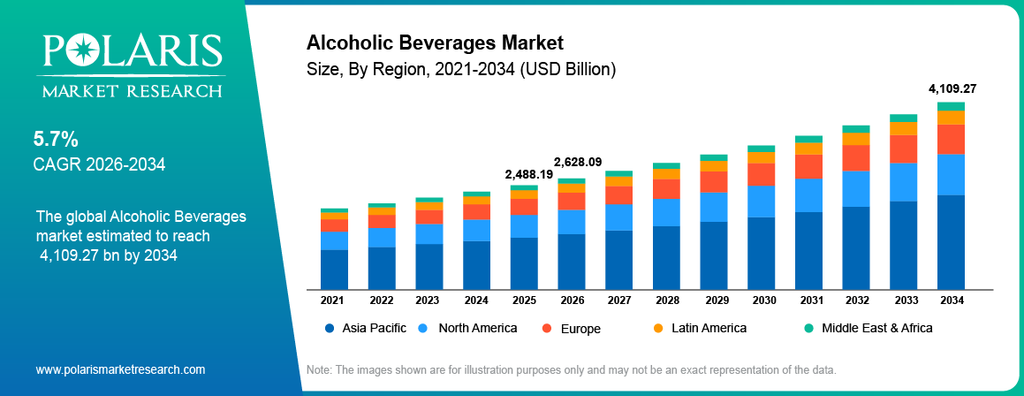
The global alcoholic beverages market was valued at USD 2,488.19 billion in 2025. Polaris Market Research projects it will reach USD 4,109.27 billion by 2034, a 5.7% CAGR. But the headline number hides the real story. Growth is no longer a volume game. Consumers are trading up to premium products, reaching for convenient formats and, increasingly, moderating how much they drink. For brand owners, the strategic question is no longer how to sell more, but how to sell something more valuable.
Premiumization: Growth Through Trading Up
Premiumization is the clearest expression of “better, not more.” Consumers are choosing higher-quality drinks with better ingredients, distinctive flavors and stronger packaging, and the shift is visible even in mass categories. Premium beer is gaining ground in developed markets such as the US and the UK, and craft brewers are winning younger drinkers with small-batch, locally rooted products.
The business implication is that price-per-serve is becoming a more reliable growth lever than volume. Beer still holds the largest share of the market at 42.3%, but spirits (5.9% CAGR) and cider, perry and rice wine (6.1%) are growing faster. Rising incomes reinforce the trend. China’s per capita income rose 5.0% in 2025, and similar gains in India, Brazil and Southeast Asia are expanding the pool of consumers willing to pay more.
Convenience Is the New Category: RTDs and Hard Seltzer
If premiumization raises the value of each drink, ready-to-drink formats widen who is drinking. Hard seltzer is forecast to be the fastest-growing type at a 7.2% CAGR, helped by easy packaging, flavor variety and broader distribution. Hybrid drinks and RTD cocktails extend the same logic.
Corporate deal-making shows how seriously incumbents take this shift. In October 2026, Constellation Brands acquired the vodka-based RTD brand SpikedAde for USD 75 million plus up to USD 278 million in performance-based payments. Molson Coors completed its acquisition of Atomic Brands, maker of Monaco Cocktails, in April 2026, positioning itself as a leading RTD cocktail supplier. United Spirits entered India’s RTD market with Smirnoff Ice in October 2026. The pattern is consistent: large players are buying growth in formats rather than waiting to build it.
The Moderation Challenge: Where “Less” Meets Opportunity
The same consumer attitudes that fuel premiumization also create headwinds. Health-conscious drinkers are cutting back, and non-alcoholic beer, wine and spirits are increasingly used as substitutes in social settings. Excise taxes compound the pressure by raising shelf prices and squeezing margins, and licensing complexity and input-cost volatility keep barriers to entry high.
Trade policy adds another layer of uncertainty. A 2025 academic analysis cited by Polaris suggests a universal US tariff increase could cut global exports of wine by 13%, spirits by 22% and beer by 33%. The sensible response is portfolio breadth. Companies are launching lower-alcohol cordials and liquors and lower-calorie beers, turning moderation from a threat into a product category.
Channels: Where Premium Meets Convenience
Distribution is evolving in the same direction. Liquor stores held a 25.6% share in 2025 and supermarkets 24.0%, but internet retailing is forecast to grow fastest, at a 7.9% CAGR. Online channels let brands showcase super-premium products, build direct customer relationships and gather data on preferences, where local laws allow. Pubs, bars and restaurants, growing at 6.0%, remain essential for brand-building, especially as tourism and hospitality expand.
Regional Insights: Where “Better” Is Being Defined
Asia Pacific: Scale and Aspiration
Asia Pacific led with a 38.5% share in 2025, supported by a large consumer base, rising incomes and growing organized retail and e-commerce. China is forecast to grow fastest, at a 6.3% CAGR, as consumers adopt beer, premium gin and tequila. India is shaped by demographic shifts and a growing appetite for local spirits and flavored beverages. Carlsberg’s plan to double Indian brewing capacity from 80 to 160 million liters shows where investment is flowing.
North America and Europe: Premium and Mature
North America is projected to grow at 5.6%, with interest in premium Scotch whisky and lower-calorie beer. Europe, at 5.0%, relies on deep drinking culture, tourism and hospitality, with premium spirits, craft beer and RTD cocktails adding momentum.
Latin America and the Middle East & Africa
Latin America is forecast at 5.9%, supported by a rising middle class and tourism. The Middle East and Africa, at 5.0%, grow mainly through hospitality in markets where alcohol sales are legal.
Competitive Landscape: Diversify or Be Disrupted
The market is led by global brewers and spirits houses, including Anheuser-Busch InBev, Heineken, Carlsberg, Diageo, Pernod Ricard, Bacardi, Constellation Brands and Molson Coors, alongside strong regional players such as Kweichow Moutai, Wuliangye and United Spirits. Competition is intense, and the strategic playbook is converging. Brewers are moving beyond beer into RTDs, flavored beverages and non-alcoholic options. Spirits companies are extending into cocktails and convenience formats. Portfolio moves such as Gallo’s April 2026 acquisition of Four Roses Bourbon show that heritage premium brands remain highly prized.
Future Outlook: Value Over Volume
Looking toward 2034, growth will likely favor companies that combine premium positioning, format innovation and flexible portfolios. AI is already helping online retailers personalize recommendations and helping producers forecast demand and optimize logistics. Expect more investment in e-commerce, emerging-market premium spirits and low-alcohol offerings, balanced against tax, tariff and regulatory risk.
Conclusion: The Winners Will Redefine “Better”
The alcoholic beverages market is expanding, but not uniformly. Its next phase will be won by brands that help consumers drink better, whether that means premium, convenient or moderate. Companies that treat premiumization, RTDs and low-alcohol options as a single portfolio strategy, rather than separate bets, will be best positioned to capture a share of the USD 4.1 trillion opportunity ahead.
Read More @ www.polarismarketresearch.com
For more information, visit @ https://www.polarismarketresearch.com/industry-analysis/alcoholic-beverages-market