Fine Mesh Screening for Industrial Applications
In industries such as food, chemicals, agriculture, metal powders and nutraceutical manufacturing, particle size consistency is not optional. A powder that dissolves unevenly, a food product with contaminants, or a chemical blend with irregular granules can compromise safety, quality, and compliance. Fine mesh screening is the quiet but essential step that prevents these problems.
Industrial screening focuses on precision, cleanliness, and contamination control. A screen in this context does more than separate material, it ensures that every downstream process is safeguarded against inconsistency. When apertures are uniform, products meet regulatory and customer standards; when they are not, entire production runs can be lost. Federal estimates indicate that roughly 48 million Americans experience foodborne illness each year—about 1 in 6 people. 96% of Class I food recalls, especially in the food and nutraceutical sectors, are tied to biological contamination, undeclared allergens, or other failures in the manufacturing environment, underscoring how critical precise screening and cleanability are to public safety and regulatory compliance. (Source: FDA, CDC, Science Direct)
Mesh Size, Aperture, and Contamination Control
The defining feature of fine mesh screening is the ability to separate powders and granules with remarkable accuracy. Mesh openings of 100 mesh and finer, sometimes 200 mesh or more, are common, allowing only particles of the correct size to pass through. A 100-mesh screen has openings of roughly 149 microns, while a 200-mesh screen is about 74 microns, fine enough to separate particles invisible to the naked eye.
Uniform apertures safeguard product consistency and performance, particularly in regulated markets where even slight deviations can have major consequences. For example, in nutraceutical applications, particle size can determine how tablets dissolve, while in advanced materials like metal powders, precision ensures reliable metallurgical properties. Research on additive manufacturing powders shows that relatively small shifts in particle size distribution—on the order of 10 microns—can significantly change powder packing density, melt behavior, and ultimately the mechanical properties of printed parts. (Source: MDPI, NIH, Journal of Manufacturing Science and Engineering)
The right screen balances mesh size with wire diameter and alloy. Stainless steel remains the most requested for food, pharma, and other industrial applications because it is corrosion-resistant, durable, and non-reactive. Alternatively, synthetic meshes or specialty alloys may be specified when essential. Contamination control is equally critical. Screens must resist product buildup and prevent cross-contamination between runs. Many customers also require traceability, so they can demonstrate that every batch of screen material aligns with FDA, GMP, or ASTM requirements.
In customer purchasing decisions, throughput tends to take priority. Manufacturers generally prefer higher processing speed, which drives production volumes. However, the right screen partner will emphasize an individualized approach, asking each customer whether throughput or screen longevity is most important to their process, since some applications benefit from extended wear life over raw output.
Screening Methods and Compliance Considerations
Industrial screening is popular in both wet and dry methods. Dry screening is standard for powders and chemicals that require fine separations without the introduction of moisture. Wet screening, by contrast, is often used for water filtration, or where dry or sticky materials benefit from liquid-assisted movement through apertures. Both methods present challenges: dry screens risk blinding from dust or electrostatic buildup, while wet screens must withstand the added weight of liquid-material mixtures and resist corrosion.
In either case, regulatory considerations are ever present. Producers in food markets must operate under FDA guidelines, while aerospace and specialty chemical manufacturers align with ASTM or ISO standards. Although screens themselves are not certified by these agencies, their design, aperture accuracy, alloy integrity, cleanability, and traceability, directly supports compliance. In industries such as food manufacturing and pharmaceuticals, industrial screening is also typically batch-based, meaning that screens need to be swapped or cleaned between production runs or when a new product is introduced. A screen that is difficult to clean or that traps material can risk contamination and cause expensive downtime. Industry analyses, including widely cited research from Aberdeen Group, estimate that unplanned downtime can cost manufacturers on the order of $260,000 per hour, making cleanable, quick-change screens a critical defense against lost productivity. (Source: TWI Institute)
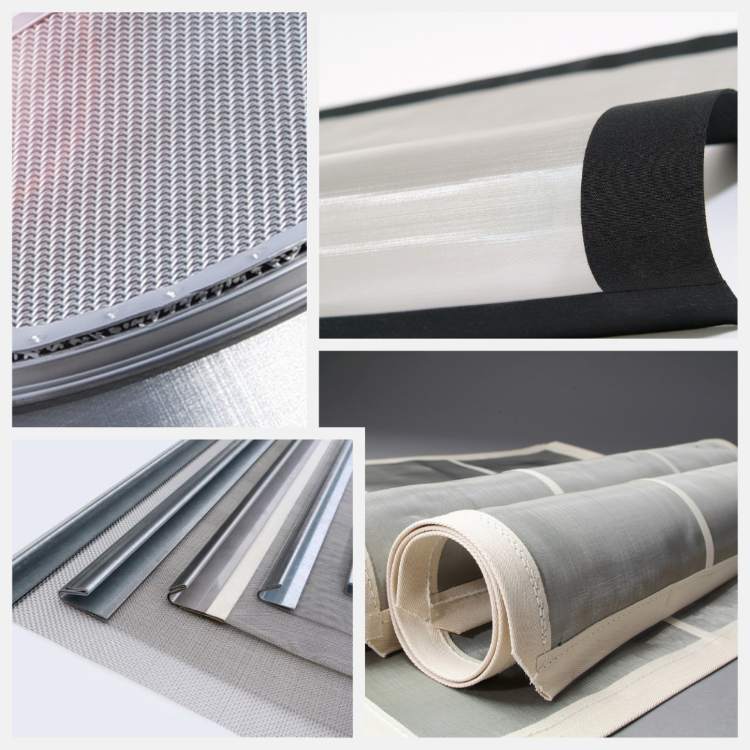
To reduce blinding, recommended configurations include ball or slider decks, “sandwich” screens, and in critical ultra-fine separations, ultrasonic systems to keep apertures clear. An easy way to speed up cleaning between batches, when working with round separators, is to use a quick clamp system. This allows for easy screen change-outs between cleanings and batch runs.
Customizing Screening for Real-World Demands
All of these factors: mesh size, aperture consistency, wire diameter, alloy choice, cleanability, and compliance alignment, create a complex decision-making process for manufacturers. While the principles apply broadly, companies benefit from working with suppliers that understand the nuances of industrial fine mesh applications. Compass Wire Cloth supports these industries with a wide range of woven wire meshes, bonded and pretensioned screens for vibratory separators, and ultrasonic-ready options for ultra-fine separations. The company’s ISO 9001:2015 certification underscores its commitment to accuracy and quality, and its ability to provide traceable alloys gives customers confidence that their screens will stand up to regulatory scrutiny. By collaborating directly with engineers and plant operators, Compass helps customers match the right mesh and configuration to their process requirements, ensuring that screening protects product integrity and keeps production lines running smoothly.
Fine mesh screening may be a small component in a larger manufacturing system, but its impact is enormous. The right screen guarantees consistent product flow, accurate particle sizing, and compliance with stringent regulations. For industries where precision defines quality, screening provides the foundation for safety and performance. By investing in better screening design and hygienic processing, companies can reduce the risk of contamination-related recalls—events that industry studies estimate have average direct costs of around $10 million per incident, before accounting for lawsuits, retailer penalties, or long-term brand damage. (Source: Food Safety Magazine, Agrivi) By understanding how mesh size, aperture uniformity, and contamination control work together, manufacturers can safeguard their operations against inefficiency and inconsistency, ensuring every batch meets the highest possible standards.