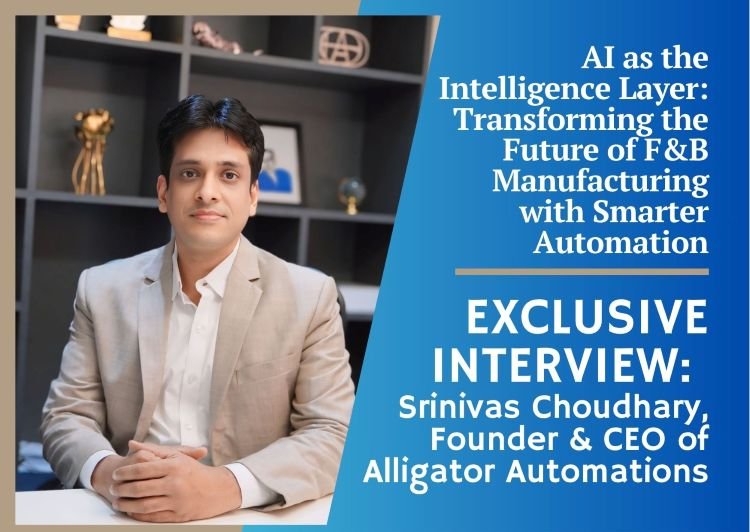
In an exclusive interview with Food – Drink & Innovations, Srinivas Choudhary, Founder & CEO of Alligator Automations, shares his insights into the evolving role of AI in food and beverage manufacturing. He discusses how AI-driven intelligence can complement existing PLC, SCADA and MES systems, reduce alarm fatigue, improve predictive maintenance, and enable faster, more informed decision-making. Choudhary also explains how Gronox connects plant data, equipment, workflows and teams to create a real-time operational view, helping F&B manufacturers move from reactive troubleshooting towards proactive, intelligent and connected operations.
- How is the shift from conventional automation to AI-driven, intelligent manufacturing changing operations in the F&B industry?
Food and beverage plants have long relied on automation across fillers, pasteurizers, CIP systems, packaging lines, and cold rooms. While these systems are highly effective at executing predefined processes, AI is adding a new intelligence layer that enables plants to understand and respond to changing operational conditions.
The shift is not about replacing PLCs or SCADA systems but connecting their data to create a more unified view of operations. AI can bring together signals such as temperature, vibration, throughput, quality, and maintenance status to identify patterns and emerging issues.
This changes operations in three key ways: moving from isolated signals to a shared operational picture, from alarm-heavy monitoring to prioritised exceptions, and from manual coordination to faster execution. For example, an identified equipment issue can trigger a work order, alert the relevant team, and support reporting while keeping humans involved in critical decisions. Ultimately, conventional automation continues to run the plant, while AI helps people run it more intelligently.
- What are the key limitations of traditional automation that an AI-based intelligence layer can address for FMCG and F&B manufacturers?
Traditional automation systems such as PLCs, SCADA, DCS, and MES are highly effective at controlling processes and ensuring that machines execute predefined instructions consistently. However, they are not designed to interpret the broader operational context or connect the dots across multiple systems. This is where an AI-based intelligence layer can add significant value.
AI can move manufacturers beyond simple threshold-based alarms by analysing patterns across production, equipment, maintenance, quality, and energy data. Instead of treating every deviation equally, it can identify which exceptions are genuinely significant and require immediate attention. It can also detect early signs of equipment or process issues before they develop into costly failures.
Another limitation is fragmented information. Operators often need to move between different systems to understand an issue and determine the appropriate response. An intelligence layer can bring relevant information together, surface historical patterns, and recommend the next action.
For FMCG and F&B manufacturers, where even minor stoppages, extended cleaning cycles, or temperature deviations can affect yield, quality, and delivery schedules, this shift is particularly important. AI does not replace existing automation; it makes the data and systems already in place more actionable, helping teams move from reactive troubleshooting to proactive decision-making.
- Gronox is designed to act as an intelligence layer over plant and equipment operations. What operational challenges was it developed to solve?
Gronox was created to help with a basic issue in modern manufacturing: the plants have no shortage of data, but actually turning that data into timely coordinated action is still hard. As operations get more intricate, the information kind of gets spread out across equipment systems, maintenance platforms, quality steps, production dashboards, and even those manual shift updates.
Teams often end up spending a lot of time gathering details, double-checking alerts, aligning across different functions, and then putting together reports… instead of actually focusing on production. And traditional alarms can flood people with lots of notifications, but they don’t always spell out the real operational meaning. By the time someone notices a trend using manual reports, the chance to avoid downtime or quality troubles might already be gone. Gronox fills this hole by building an intelligence layer that links plant data, assets, workflows, and the people involved. It adds context around what’s happening, points to what should get attention, and helps connect a discovered issue to the right next step, whether that’s a notification, a maintenance action, a quality verification, or a full escalation. The goal is pretty simple too make plant operations more visible, more situational, and more hands-on, without replacing the automation systems already running inside the factory.
- How does Gronox integrate plant and equipment data to provide operations teams with a real-time view of what is happening on the shop floor?
Gronox works with the plant’s existing systems instead of pushing manufacturers to swap out what they already have in SCADA, MES, or automation infrastructure. It kind of pulls together information from PLCs, SCADA systems, historians, IoT gateways, sensors, maintenance and asset-management platforms, plus enterprise systems, using APIs, connectors, webhooks, and telemetry applications.
Once that info lands on the platform, it gets arranged via a shared event layer, so operational events from different corners of the facility can be tied together and interpreted in context. That means teams are not stuck looking at just individual machine readings or dealing with isolated alarms, like before. Rather, they get a single real-time view of the shop floor, with equipment status, how fresh the telemetry is, active and prioritised alerts, maintenance activities, pending approvals, and other operational signals that matter. And the best part is the same stream can be used through dashboards, in-app alerts, or even the AI assistant. So production maintenance and supervisory teams end up using a common operational picture.
Instead of spending time merging data across multiple systems, they can work from the same live context and respond sooner when something starts going wrong. In short, Gronox turns fragmented plant data into a connected and actually actionable view of operations.
- How does AI help Gronox distinguish between routine operational variations and issues that require immediate attention?
In F&B manufacturing, not every deviation indicates a problem. Equipment behaviour naturally changes during changeovers, CIP cycles, recipe transitions, and other routine operations. Gronox uses AI to place these signals in the right operational context.
The platform combines established rules for safety, hygiene, and critical limits with AI-driven analysis of equipment history, current processes, recent events, and maintenance activity. This allows the system to assess whether a deviation is consistent with normal operating behaviour or indicates an emerging issue.
By adding context to individual machine signals, Gronox reduces unnecessary alerts and helps teams focus on exceptions that genuinely require attention. This enables faster decisions while reducing alarm fatigue and supporting more proactive operations.
- In an F&B manufacturing environment, how can AI-powered monitoring help reduce unplanned downtime, production losses, and equipment-related disruptions?
AI-powered monitoring can help F&B manufacturers move from reacting to equipment failures to identifying potential issues before they disrupt production. By continuously analysing signals such as vibration, temperature, current, cycle time, and equipment performance, Gronox can identify early patterns that may indicate developing faults.
The system can then place these signals in production context, helping teams prioritise issues based on their potential impact on output, quality, and food safety. A developing issue on a critical production asset, for instance, can receive greater attention than a similar signal from a non-critical system.
Gronox can also connect monitoring with maintenance workflows, allowing relevant evidence to accompany work orders and alerts to reach the appropriate teams. This creates a faster response cycle and reduces dependence on manual handovers.
Ultimately, the goal is to detect issues earlier, respond faster, reduce unplanned downtime, and minimise production and product losses.
- Can you share an example of how Gronox can move from identifying an issue to triggering an automated workflow, report, or notification to the relevant team?
A typical example is a pasteurizer showing a gradual temperature drift alongside rising motor load. Gronox receives the telemetry from the existing PLC/SCADA environment and evaluates the event against operating rules and historical patterns.
The AI layer can assess the signal in context by reviewing the product being processed, recent equipment behaviour, related assets, and previous incidents. If the pattern suggests a developing issue, Gronox can generate a case outlining the likely cause, potential production or quality impact, and recommended action.
The system can then notify the relevant supervisor, create and prioritise a maintenance work order, and involve the quality team if required. Where approvals are necessary, the workflow can pause for human confirmation before execution.
Once the issue is resolved, the outcome is recorded against the asset and reflected in operational reporting. This creates a continuous signal-to-action-to-learning loop, reducing manual coordination and enabling faster, more informed responses.
- How can F&B manufacturers integrate an AI intelligence layer with their existing automation infrastructure without completely overhauling their current systems?
F&B manufacturers do not need to replace their existing automation infrastructure to adopt an AI intelligence layer. Gronox is designed to work alongside PLCs, SCADA, MES, historians, IoT gateways, and other established systems, allowing manufacturers to build intelligence around their existing operations.
Data can be connected through APIs, webhooks, historians, gateways, and dedicated connectors, while approved workflows determine when information can trigger actions. This approach lets the existing control systems keep managing production while Gronox adds intelligence, monitoring, alerts, and workflow automation, all at once more or less.
Manufacturers can start with a focused pilot on one bottleneck line, a utility, or a critical asset instead of trying a plantwide transformation. AI might begin in an observation and recommendation mode. Then automation gets expanded as teams build confidence, and not before. That makes adoption more practical, while still keeping governance, role-based access, auditability, and human approval for those critical decisions. In plain language, it’s like this: existing automation carries on running the plant, while Gronox provides the intelligence needed to run it more proactively.
- Looking ahead, how do you see “AI as an intelligence layer over automation” shaping the future of F&B manufacturing, and what role does Alligator envision playing in this transformation?
The future of F&B manufacturing will be shaped not simply by automation but by how intelligently automated systems can be managed and improved. AI will increasingly act as an intelligence layer, enabling plants to move from constant monitoring to exception-based operations, where routine processes remain automated while teams focus on issues affecting quality, yield, energy, and output.
AI will also build operational context over time by learning from equipment behaviour, product requirements, and previous interventions. This will enable more proactive, outcome-driven operations.
Alligator envisions Gronox supporting this transformation by connecting existing automation with AI-driven applications, workflows, and governed actions. The goal is not to replace existing systems but to help F&B manufacturers make their plants more connected, proactive, and increasingly intelligent.