By: Ray Niemeyer, Vice President of Sales at SpaceGuard Products
Walk the floor of a food distribution center, a pharmaceutical clean room, or a cold storage facility, and it becomes clear very quickly that these environments demand a lot from their equipment. Temperature extremes, persistent moisture, aggressive sanitation chemicals, and forklift traffic combine to create conditions that carry the potential to expose every weakness in guarding and rack systems. For facilities managers and safety professionals operating in these spaces, understanding how wire mesh partitions and pallet rack components respond to those stressors can mean the difference between a safe, efficient operation and a costly, potentially catastrophic failure. Therefore, the goal should be to utilize the right materials while employing proper safety and maintenance protocols from the outset.
Zone by Zone: Cold Storage and Its Challenges
Cold storage facilities typically comprise three distinct zones, each presenting its own set of material challenges. Blast freezers operate at roughly -20°F and store frozen products, such as ice cream. Middle freezers run between 0°F and 20°F for prepackaged frozen foods. Cooler areas, kept between 33°F and 40°F, store perishables like produce, dairy, and proteins that must arrive at retail destinations on time and fresh.
In cooler areas, hazards are largely moisture-driven. Produce may be misted directly, and floor sanitation methods often involve chemical washes that pool and splash on every surface within six to eight inches of the ground. Rack uprights, guard rails, and other steel components are particularly vulnerable to corrosion in this six to eight-inch range—that is, their base, the precise location where structural integrity matters most. In freezer zones, the more pressing threat is physical: moisture is largely absent, with these zones being below freezing, but forklift traffic is heavy. Human error leads to repeated impacts on uprights, utility lines, fans, and sprinkler systems suspended overhead or running floor-to-ceiling.
Despite these differences, what these zones share is a history of being underprotected. Guarding systems and rack protection are rarely included in original facility budgets; instead, they get added reactively after damage has already occurred and utilities have already been compromised. That reactive approach is both expensive and dangerous.
Material Selection: A Hierarchy That Matters
In any environment that involves moisture, temperature extremes, or chemical exposure, material selection matters. The industry observes a clear structural performance hierarchy for wire mesh and rack coatings. Liquid spray paint sits at the bottom, offering minimal resistance to corrosion and mechanical wear. Powder coating, being durable and cost-efficient, represents a significant step-up and is the most widely used finish in food and cold storage applications. Zinc plating offers better resistance in wet environments. Hot-dip galvanizing provides the highest level of corrosion protection out of these options, but there is a trade-off. Galvanized mesh, for instance, can develop sharp, icicle-like drips from the dipping process at wire edges and frame junctions. When those deposits break off, they expose new areas of bare metal susceptible to corrosion. In practice, powder coat holds up well in most cold storage and food processing applications, but only when applied properly to a clean substrate and promptly maintained when scratches or cuts expose bare steel. Any break in the coating becomes a point of vulnerability where rust can develop during freeze-thaw cycles.
Wire gauge and mesh opening size are equally important variables. Standard industrial partitions use 10-gauge wire with two-inch square openings, sufficient for most food processing and cold storage applications, where the primary function is zone separation, pedestrian protection, and inventory security. Heavier 6-gauge wire is specified where greater impact resistance is needed. Smaller openings—one-inch square, half-inch square, or even solid panels—are used where theft deterrence or line-of-sight restrictions are priorities. The tradeoff is straightforward: the smaller the opening, the greater the security, but also the greater the material weight and cost. These variables double with coatings.
Food and beverage processors that operate in USDA- or FDA-regulated spaces face sanitation requirements that go beyond corrosion resistance. Facilities handling open products including beef, poultry, and fresh produce, must comply with specific paint and coating standards to earn regulatory approval. The responsibility for knowing those requirements rests with facility operators, who must communicate applicable standards to guarding manufacturers at the time of specification. A manufacturer cannot assume compliance without that input.
Rack Integrity and Repair: The Hidden Safety Crisis
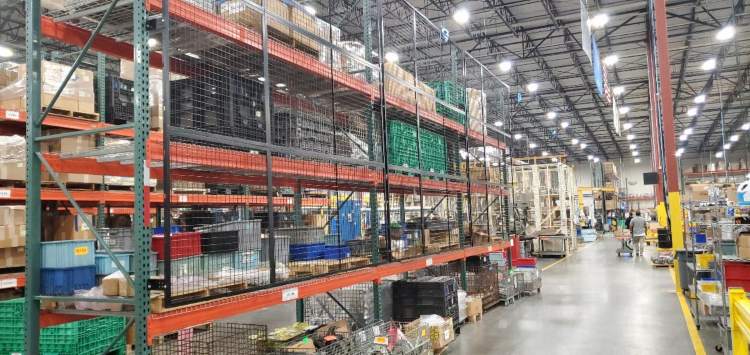
Beyond guarding systems, pallet rack integrity is one of the most unaddressed safety concerns in cold storage and food distribution facilities. The structural logic is straightforward but frequently misunderstood: a rack system is an interconnected framework, and a single damaged upright compromises load capacity across the entire row. Take a 30-bay rack with 60 uprights. When even a few uprights are bent, compressed, or cracked, the capacity of the system degrades silently until, under the right load conditions, all 30 bays collapse in a domino sequence. Undoubtedly, compromised upright integrity on this scale can be lethal. A single bay can hold 20,000 to 30,000 pounds of product. This product becomes a hazard the moment the rated capacity of its uprights is no longer reliable.
The industry has developed engineered repair solutions that address this risk without requiring full tear-out and replacement. Modular rack repair kits allow maintenance teams to isolate a damaged upright section safely, cut out the compromised material, and install a replacement component that meets or exceeds the original manufacturer’s load rating. SpaceGuard Products, a North American leader in wire mesh security solutions, CenturionTM rack repair kits are a prime example: this system is designed with adjustable bracing to accommodate varying upright depths, bolt-on brackets that connect to intact horizontal and diagonal braces, and certified with seismic compliance testing that ensures stability through uncontrollable, unforeseeable disasters—an important consideration for facilities in earthquake-prone regions such as California, Tennessee, and Washington.
Adjustable bracing in repair kits like the CenturionTM allows facilities to provide the necessary support for previously failed uprights to regain and maintain their optimal target capacity. The CenturionTM repair kit takes this a step further. Typical rack structure sees horizontal and diagonal braces running between uprights. CenturionTM is designed such that, if the brace is not damaged, it can leverage the still-intact part of the rack via the brace to repurpose and utilize the compromised upright without waste. But in the event the bracing is damaged in a manner where this is not possible, or the type of bracing does not allow for a quality connection, SpaceGuard will quote a new kit with all new bracing in that area to reinforce the upright fully, meeting and exceeding the original OEM product design.
Rack repair systems are most valuable when the damaged upright is caught early. The economic and safety case for repair over replacement is compelling: a repair kit addresses the problem at the source without requiring the rack to be emptied, dismantled, and rebuilt. But the case collapses entirely when damage accumulates unaddressed. One tool manufacturer with a distribution center that had been operating for seven years faced a safety audit that revealed more than 2,100 damaged uprights. The remediation cost, including materials and labor, was projected at approximately $2.5 million, a direct consequence of never establishing a maintenance budget line item for rack and guarding repair.
Getting on the Same Page: Education, and a Common Language for the Future
The most persistent challenge in cold storage and food processing facilities is not material science or engineering, but procurement culture. Capital budgets cover new racking, new guarding, new equipment. Maintenance budgets cover docks, trucks, and HVAC. This leaves rack and guarding repair in no man’s land, addressed only when a safety audit forces the issue or a failure makes it unavoidable.
The industry’s response is a growing body of standards compiled by the Protective Guarding Manufacturers Association (ProGMA) aimed at giving buyers a common language for specifying protective systems. ANSI MH31.1 covers impact testing for guarding products, establishing a tiered good-better-best framework that directly correlates a product’s price point with its resistance to forklift impact. ANSI MH31.2 employs the same testing framework for steel and polymer guard rails. ANSI MH31.3 addresses topple barriers—a category often overlooked in facilities where non-racked, stacked product lies near high-traffic pedestrian aisles or forklift lanes. For rack repair specifically, the relevant benchmark is ANSI MH16.1, standard that defines minimum load capacity and structural performance requirements.
Pairing these standards with a proactive maintenance budget, one that treats rack and guarding repair as a necessary, regular operational cost rather than a sudden capital emergency, is the most reliable way to keep cold storage and clean room environments safe, compliant, and running. The facilities that do this well don’t find themselves negotiating seven-figure repair projects under audit pressure. They address damage in months rather than years, keep capacity ratings reliable, and protect the workers, product, and infrastructure that depend on every component performing exactly as designed.
Products and materials are always evolving and improving. The biggest thing that impacts applications is industry and customer education. The industry must work with safety departments to provide better educational information for buyers to help them comprehensively understand the current landscape, so that when they request quotes for new guarding, rack, or rack repair kits, they have the necessary information to buy the proper product, because the proper product in this instance means a safer and more efficient industry environment for companies and clients alike.