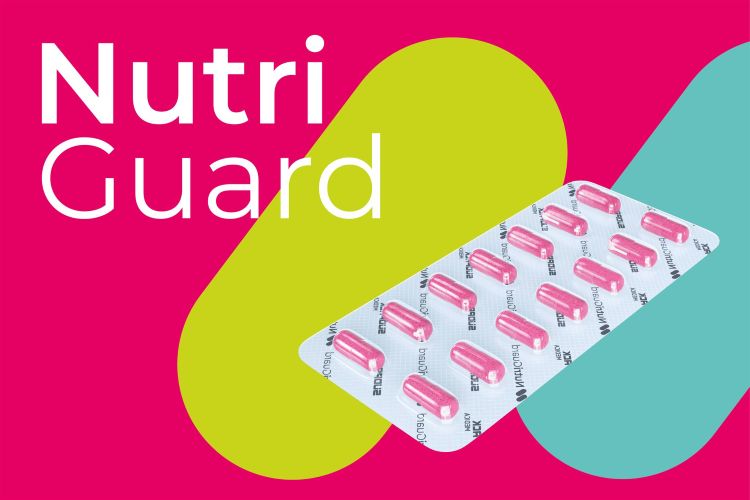
With the EU Packaging and Packaging Waste Regulation (PPWR) set to take effect in August 2026, the nutraceuticals market will also need to prepare for significantly stricter requirements by 2030 at the latest. Against this backdrop, SÜDPACK Medica will showcase its innovative NutriGuard® blister solution at Vitafoods Europe (Booth 5H22) – and the timing could hardly be better. Based on current calculation standards, this PP-based primary packaging for nutraceuticals such as vitamins, minerals, and supplements (VMS) already meets the PPWR requirements for recyclability.
The packaging market is facing profound change, and new packaging regulations are calling the status quo into question. The broader nutraceutical market – including food supplements – will also be directly affected. And the impact will come sooner, and be more far-reaching, than is widely expected.
Nutraceuticals – a special case under packaging law
At the same time, it is becoming increasingly clear that the nutraceuticals market follows neither the logic of traditional food packaging nor purely pharmaceutical standards. Nutraceuticals occupy a field of application that overlaps in substantive terms with the pharmaceutical industry. Despite this close connection, however, nutraceuticals are governed not by pharmaceutical law, but by food law. Accordingly, they are also subject to the relevant food-grade requirements for packaging materials and packaging concepts under the PPWR: From 2030 onward, packaging must be at least 70% recyclable in line with EU standards and contain 10% PCR (post-consumer recyclate).
The reality is that distinct regulatory frameworks, sensitive ingredients, and changing market requirements all necessitate an independent packaging concept for nutraceuticals – one developed specifically for this market and deliberately separated from conventional pharma-oriented blister concepts. This is precisely the gap that NutriGuard® from SÜDPACK Medica is designed to close – as a forward-looking solution developed specifically for the food supplements market.
A booming market
At the industry event taking place in Barcelona from May 5 to 7, SÜDPACK Medica is therefore expecting strong demand for NutriGuard®. One reason is that manufacturers must now address the new packaging-related challenges and begin transitioning to a PPWR-compliant packaging system as quickly as possible. Another is the market’s continued growth, particularly for minerals, vitamins, and antioxidants: While the market for nutraceuticals alone was estimated at around USD 100 billion in 2025, it is forecast to reach USD 220 billion by 2034. With a market volume of just under USD 29 billion and a 29% share, Europe currently dominates this lucrative global market segment alongside Asia-Pacific and the United States.
Tablets are expected to remain the most widely used format worldwide in 2026, accounting for more than 38% of the market, followed by capsules and gel caps. The reasons are clear: high consumer acceptance, longer shelf life, easier dosing, and greater dosing accuracy compared with liquids and other dosage forms. Compared with canisters or bottles, blister packaging also offers a high level of product protection, as the individual tablets remain protected from moisture and similar external influences in separate cavities until consumption. In addition, blister packaging is highly efficient in terms of packaging materials.
NutriGuard – a future-proof solution for the challenges facing the industry
NutriGuard is a pioneering packaging concept for the industry that not only ensures product protection, but also focuses on PPWR compliance. As such, this blister solution is an important building block on the path toward a circular economy and greater sustainability in the plastics and packaging industry.
With NutriGuard, a packaging system based on PP thermoforming film and lidding film, SÜDPACK Medica is applying the expertise gained from developing its multiple award-winning PharmaGuard® blister concept to the specific requirements of the nutraceuticals market.
As a true mono-material solution, the packaging can be fed into existing European PP recycling streams, and its recyclability can be certified by an independent institute. In addition, SÜDPACK Medica offers NutriGuard with a 10% PIR (post-industrial recyclate) content sourced from its in-house mechanical recycling process. Going forward, an enhanced version of this solution will also make it possible to meet the 10% post-consumer recyclate content required under the PPWR. By switching to recyclable packaging, manufacturers and packagers also stand to benefit from the EPR (Extended Producer Responsibility) fees that will be tightened progressively across the EU from 2026 onward. These fees are based on environmental impact and recyclability – and will be lower for sustainable solutions.
However, these are by no means the only advantages of NutriGuard. PP also offers a significantly better overall carbon footprint than PVC/PVdC + aluminum or PET (according to analyses by the Pharma Manufacturing Forum), and is already being selected by leading pharmaceutical companies as a future-proof packaging material for low to medium barrier requirements.
NutriGuard also delivers in terms of usability and processing – for example, thanks to the lidding film’s excellent push-through performance. By producing the compounds in-house, SÜDPACK can tailor the film for particularly easy handling and for use with a wide range of tablet and capsule types. At the same time, this packaging concept, with its precisely matched thermoforming and lidding films, supports efficient machinability even at high cycle speeds. The lidding film also offers excellent printability with GIO-compliant inks – in other words, inks that are suitable for food contact. Especially in the premium segment, this opens up clear marketing and branding benefits.