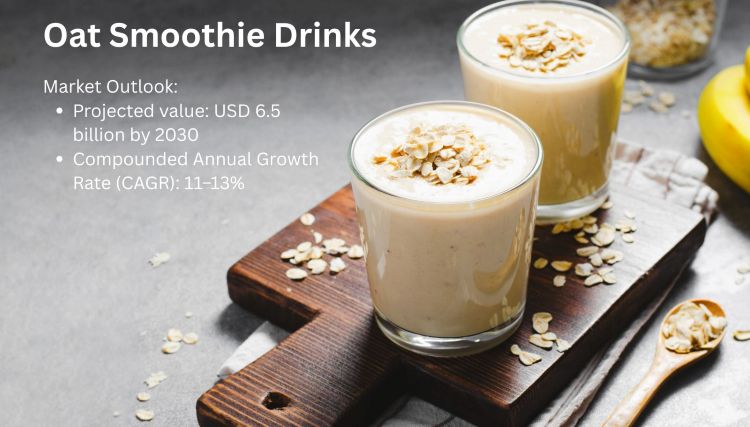
The global oat smoothie drinks market is rapidly evolving from a niche plant-based category into a mainstream functional beverage segment. According to the latest market intelligence by Marketintelo, the global Oat Smoothie Drinks Marketwas valued at approximately USD 2.8–3.2 billion in 2024 and is projected to surpass USD 6.5 billion by 2030, growing at a CAGR of 11–13% during the forecast period. This expansion reflects a deeper shift in consumer behaviour, where drinks are no longer consumed merely for taste or hydration but for health, convenience, and performance outcomes.
At first glance, the trajectory appears straightforward: rising lactose intolerance, increased vegan adoption, and sustainability concerns are driving demand for oat-based alternatives. However, beneath this optimistic outlook lies a more layered reality one where customer retention, pricing pressures, and product differentiation will determine the long-term winners.
The oat smoothie drinks market is transitioning from a trend-led category into a strategy-led industry, and this shift is redefining how companies compete, innovate, and scale.
Market Reality vs. Hype: The Retention Challenge
The early success of oat-based beverages has led to a widespread assumption that demand will continue to rise uniformly. However, market data suggests a divergence between trial and sustained consumption.
• Over 60–65% of urban customers have tried oat-based drinks
• Only 35–40% evolve into repeat customers
This discrepancy highlights a critical issue: initial curiosity is not translating into habitual consumption. The novelty of plant-based products has driven experimentation, but repeat purchases depend on more grounded factors such as taste consistency, pricing, and daily usability.
Another overlooked challenge is category overlap. Oat smoothies are not competing in isolation; they are positioned within a highly crowded beverage landscape that includes dairy smoothies, protein shakes, cold coffees, and other plant-based replacements like almond and soy drinks.
As a result, the growth narrative is shifting from “category expansion” to “share capture”, where brands must actively win over customers rather than rely on organic demand growth.
Consumer Behaviour: Intent, Perception, and Purchase Gaps
Consumer perception of oat smoothie drinks is largely positive, driven by associations with health, sustainability, and modern lifestyles. However, actual purchasing behavior reveals a more complex dynamic.
A significant proportion of customers view oat smoothies as a “better-for-you” alternative, particularly for digestive health and heart wellness. Beta-glucan content in oats has been widely marketed as beneficial, reinforcing this perception.
At the same time, practical considerations dominate final purchase decisions:
• More than 50% of customers are highly price-sensitive
• Around 30–35% still prefer dairy taste profiles
• Nearly 40% consume oat smoothies occasionally rather than daily
This creates a behavioural gap between aspiration and action. While customers want to adopt healthier alternatives, they are not always willing to compromise on taste or pay a premium consistently.
The primary consumer base includes:
• Urban millennials and Gen Z
• Health-conscious professionals
• Flexitarian customers (not strictly vegan but reducing dairy intake)
Interestingly, the rise of flexitarianism is more influential than strict veganism. This means the market’s growth depends less on niche dietary groups and more on mainstream behavioural shifts, which are inherently slower and more complex.
Key Growth Drivers: Structural Shifts Supporting Expansion
The oat smoothie drinks market is supported by several long-term structural drivers that extend beyond short-term trends.
One of the most important drivers is the rise of functional nutrition. Customers are increasingly expecting beverages to deliver tangible health benefits, such as improved digestion, sustained energy, or enhanced immunity. Oat smoothies, with their fiber-rich profile, are well-positioned to meet these expectations.
Sustainability is another critical factor. Compared to dairy and even some plant-based alternatives like almonds, oats have a lower environmental footprint, requiring less water and land. This aligns with the growing demand for environmentally responsible consumption.
Distribution is also playing a transformative role. The expansion of quick-commerce and direct-to-consumer channels has made oat smoothie drinks more accessible, particularly in urban areas where convenience is a key purchasing driver.
At the same time, evolving lifestyles characterized by busy schedules and reduced meal preparation time are increasing reliance on ready-to-drink nutritional options, further supporting demand.
Usage Patterns: Expanding but Not Yet Universal
Oat smoothie drinks are gradually diversifying in terms of usage occasions. Traditionally associated with breakfast, they are now being consumed across multiple contexts, including as meal replacements, post-workout beverages, and mid-day snacks.
However, their usage remains situational rather than habitual. Unlike coffee, tea, or soft drinks, oat smoothies have not yet become an integral part of daily consumption routines for most customers.
This limitation has important implications for market growth. While the category is expanding, its total addressable volume is constrained by the lack of high-frequency consumption behaviour.
To unlock the next phase of growth, brands will need to reposition oat smoothies as everyday beverages rather than occasional health products.
Innovation & Differentiation: The Double-Edged Sword
Innovation is both a key growth enabler and a potential risk factor in the oat smoothie drinks market. A significant portion of new product launches focuses on enhancing nutritional value through added protein, probiotics, vitamins, and adaptogens.
• Approximately 40–45% of new products include functional enhancements
Flavor innovation is also expanding rapidly, with combinations such as oat + berries, oat + chocolate, and oat + coffee gaining popularity. These innovations are helping brands appeal to a broader audience and reduce the perception that oat-based drinks are bland or niche.
However, the underlying challenge is that core formulations are relatively easy to replicate. This creates a risk of commoditization, where multiple brands offer similar products with minimal differentiation.
In such an environment, success depends not just on product innovation but also on:
• Brand storytelling
• Packaging differentiation
• Distribution strength
• Consumer trust
Without these elements, even innovative products can struggle to maintain a competitive edge.
Competitive Landscape: Intensifying Market Pressure
The oat smoothie drinks market is becoming increasingly competitive as both established beverage companies and emerging startups enter the space.
Large players bring advantages in scale, supply chain efficiency, and distribution reach, allowing them to compete aggressively on pricing. Startups, on the other hand, focus on innovation, niche positioning, and premium branding.
Despite strong demand fundamentals, the category faces persistent challenges:
• Pricing remains higher than traditional dairy alternatives
• Taste perception continues to influence adoption
• Shelf space is becoming increasingly competitive
As competition intensifies, the market is witnessing a gradual shift toward value-based competition, where customers evaluate products based on a combination of price, taste, and functional benefits.
Economics & Profitability: Growth Without Guaranteed Returns
One of the most critical aspects of the oat smoothie drinks market is the disconnect between revenue growth and profitability.
While demand is increasing, cost structures remain complex. Key cost drivers include raw material sourcing, processing, packaging, and logistics. For fresh or minimally processed products, cold chain requirements further increase operational expenses.
Marketing is another significant cost center, particularly for new brands attempting to build awareness in a crowded market. At the same time, private label products are gaining traction, offering lower-priced alternatives that put pressure on branded margins.
This creates a challenging environment where companies must balance growth ambitions with financial sustainability. Scaling the business does not automatically lead to improved profitability unless operational efficiencies are achieved.
Regional Insights: Uneven Growth Dynamics
The global oat smoothie drinks market exhibits significant regional variation.
North America remains the largest market, accounting for approximately 35–38% of global share, driven by high consumer awareness and strong adoption of plant-based diets. Europe follows closely, supported by regulatory support for sustainable products and a strong preference for clean-label foods.
Asia-Pacific represents the fastest-growing region, with a projected CAGR of 16–18%. Rapid urbanization, rising disposable incomes, and increasing awareness of lactose intolerance are driving demand. However, affordability remains a major barrier, particularly in price-sensitive markets such as India and Southeast Asia.
These regional differences highlight the importance of localized strategies, as consumer preferences, pricing sensitivity, and distribution infrastructure vary significantly across markets.
Regulatory & Structural Challenges
The oat smoothie drinks market is also influenced by a range of regulatory and structural factors. Labeling restrictions in certain regions limit how plant-based products can be marketed, particularly in relation to dairy terminology.
Food safety standards for ready-to-drink beverages require strict compliance, increasing operational complexity. Additionally, global supply chains for oats can be affected by climate variability and trade regulations, impacting pricing and availability.
These challenges require companies to adopt flexible strategies and invest in compliance, particularly when expanding into new markets.
Common Misconceptions
Several misconceptions continue to shape market narratives:
• The belief that all plant-based categories will grow uniformly ignores significant variation in consumer adoption
• The assumption that health benefits alone drive loyalty overlooks the importance of taste and price
• The expectation of sustained premium pricing fails to account for increasing competition and consumer sensitivity
Understanding these misconceptions is critical for developing realistic growth strategies.
Future Outlook: A Shift Toward Maturity
Looking ahead, the oat smoothie drinks market is expected to approach USD 9 billion by 2030, with growth stabilizing as the category matures.
• Growth will increasingly come from product innovation and market penetration rather than new consumer acquisition
• Functional and personalized nutrition will drive premium segments
The next phase of growth will be defined by the ability to deliver consistent value at scale, rather than relying on trend-driven demand.
𝗟𝗲𝗮𝗱𝗶𝗻𝗴 𝗖𝗼𝗺𝗽𝗮𝗻𝗶𝗲𝘀 𝗶𝗻 𝘁𝗵𝗲 𝗠𝗮𝗿𝗸𝗲𝘁
- PepsiCo, Inc.
- Danone S.A.
- Nestlé S.A.
- Oatly Group AB
- The Hain Celestial Group, Inc.
- Califia Farms, LLC
- SunOpta Inc.
- Earth’s Own Food Company Inc.
- Alpro (a Danone company)
- Rude Health Foods Ltd.
- Pacific Foods of Oregon, LLC
- Elmhurst 1925
- Happy Planet Foods Inc.
- Pureharvest
- Vitasoy International Holdings Limited
- Chobani LLC
- Minor Figures Ltd.
- Plenish Cleanse Ltd.
- Provamel (a Danone brand)
- MOMA Foods Ltd.
Conclusion:
The oat smoothie drinks market is at a pivotal stage in its evolution. What began as a plant-based trend is now becoming a competitive, performance-driven industry where success depends on execution rather than positioning.
The key to long-term success lies in addressing the fundamental gaps between consumer expectations and product delivery. Taste, affordability, functionality, and accessibility must all align to create a compelling value proposition.
Companies that can successfully navigate these challenges will not only capture market share but also define the future of the category. Those that rely solely on the plant-based narrative, however, risk being outpaced in a market that is rapidly moving beyond hype toward measurable performance and sustainable growth. Source: https://marketintelo.com/report/oat-smoothie-drinks-market